Can You Do a Taj Mahal Tour from Delhi in One Day?
Yes, you can absolutely visit the Taj Mahal from Delhi and return on the same day. In fact, a one-day trip is one of the most practical ways to experience Agra when your itinerary is centered around Delhi. The two cities are well connected by road and rail, and with an early start, you can comfortably visit the Taj Mahal, explore Agra Fort, enjoy lunch, and head back to Delhi before the evening gets too late. The key is to plan the day around travel time rather than trying to squeeze every attraction in Agra into a few hours.
For first-time visitors to India, the idea of leaving Delhi in the morning, seeing one of the world's most recognizable monuments, and returning to the capital at night can sound ambitious. But it is quite manageable. The distance between Delhi and Agra is roughly 200–240 kilometers depending on your starting point and route, and modern transport has made the journey considerably easier. A well-organized Taj Mahal Tour from Delhi can therefore give you an unforgettable experience without requiring an overnight stay.
How Long Does It Take to Travel from Delhi to Agra?
The journey from Delhi to Agra generally takes around three to four hours by road, although actual travel time depends on your pickup location, traffic, road conditions, and the time of day. The Yamuna Expressway provides a direct route for many road travelers and has made the Delhi–Agra journey much more convenient. If you choose a train, the journey can be considerably shorter on selected services, which makes rail travel an attractive option when every hour of your day matters.
Your choice of transportation should depend on what kind of trip you prefer. A private car or taxi gives you freedom and convenience because you can leave Delhi at your preferred time and travel directly between attractions once you arrive in Agra. A train, on the other hand, can be efficient if you prefer avoiding highway traffic and are comfortable planning your day around fixed departure times. Either option can work well for a one-day visit.
The most important point is to avoid starting late. The Taj Mahal is not an attraction you want to rush through after spending half your day traveling. Leaving Delhi early gives you a buffer for unexpected delays and allows you to reach Agra while you still have plenty of time for sightseeing. If you are planning a Taj Mahal Tour from Delhi, treating the departure time as an important part of the itinerary will make the entire experience smoother.
What Is the Best Way to Reach the Taj Mahal from Delhi?
There are two particularly practical choices for a day trip: traveling by private vehicle or taking a train. Each has advantages, and the better option depends on whether you value flexibility or speed.
Traveling by Private Car or Taxi
A private car is probably the simplest choice for travelers who want a door-to-door experience. You can arrange pickup from your hotel, apartment, or another convenient location in Delhi, travel directly to Agra, and keep the same vehicle for sightseeing throughout the day. This eliminates the need to find local transportation after reaching Agra.
Another benefit is flexibility. Suppose you finish exploring the Taj Mahal earlier than expected and want to visit Agra Fort immediately. You can simply continue. If you want lunch at a restaurant along your route, you can make that decision without worrying about missing a scheduled train. For families, couples, and small groups, the convenience can be especially valuable.
The downside is that road travel is dependent on traffic. Delhi's roads can become busy, particularly during peak periods, and even a well-planned journey can encounter delays. For that reason, an early departure remains important.
Traveling by Train
Train travel can be an excellent alternative, especially for visitors who want to minimize road travel. Several services connect Delhi and Agra, and some fast trains can make the journey surprisingly quick. Depending on the service and timetable available for your travel date, rail can give you more sightseeing time in Agra than a conventional road journey.
However, train travel requires more planning. You need to reach the station on time, account for the journey from your Delhi accommodation to the station, and arrange transportation between Agra station and the monuments. Once you consider those transfers, the difference between train and private car may be smaller than it initially appears.
For independent travelers, trains are often a fun part of the Indian travel experience. For visitors who want a completely hassle-free day, a private vehicle or professionally organized tour may be more comfortable.
What Does a One-Day Taj Mahal Itinerary Look Like?
A successful day trip does not need to be complicated. The goal should be to see the most important sights while leaving enough breathing room for meals, photography, security checks, and transportation.
| Approximate Time |
Activity |
| 5:00–6:00 AM |
Depart from Delhi |
| 8:00–9:00 AM |
Arrive in Agra |
| 9:00 AM–12:00 PM |
Visit the Taj Mahal |
| 12:00–1:00 PM |
Lunch |
| 1:00–3:00 PM |
Explore Agra Fort |
| 3:00–4:00 PM |
Optional local sightseeing or shopping |
| 4:00–5:00 PM |
Begin return journey |
| Evening |
Arrive back in Delhi |
These times are only a planning framework rather than a guaranteed schedule. Actual travel and sightseeing times vary according to your transportation, season, queues, traffic, and the amount of time you want to spend at each monument.
Start Your Journey Early
The earlier you leave Delhi, the more comfortable your day will feel. An early morning departure means you can reach Agra with enough time to explore rather than constantly checking your watch. It also gives you some protection against unexpected delays.
Early travel has another advantage: the atmosphere can be more pleasant. Depending on the season, Agra can become hot and crowded later in the day. Arriving earlier can make your visit more enjoyable, especially if you want photographs of the Taj Mahal without feeling as though you are competing with the entire crowd for the perfect viewpoint.
If you are traveling during India's hotter months, starting early becomes even more valuable. The morning can be significantly more comfortable than the afternoon, and you can complete your most important sightseeing before the heat becomes intense.
Visiting the Taj Mahal
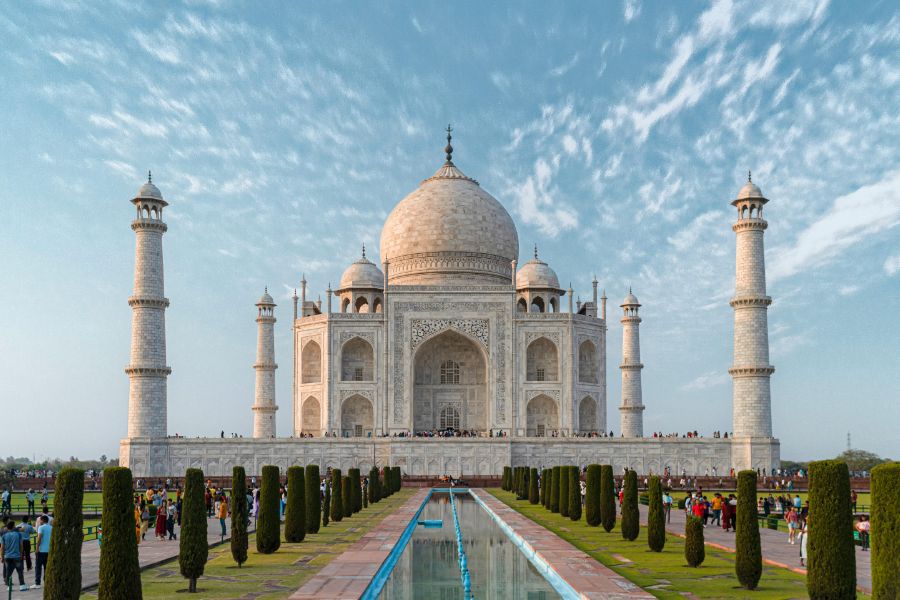
The Taj Mahal is the centerpiece of the trip, and it deserves more than a quick photograph from the entrance. Built by Mughal emperor Shah Jahan in memory of his wife Mumtaz Mahal, the monument is celebrated for its white marble architecture, symmetrical gardens, decorative details, and enormous cultural significance.
When you first see the Taj Mahal through the main gateway, the experience can feel almost cinematic. The monument appears framed by the gateway, with the long reflecting pool and gardens leading your eyes toward the central structure. It is one of those places where photographs are useful, but they do not completely capture the feeling of standing there yourself.
Give yourself at least two hours if your schedule permits. This allows time to walk through the complex, appreciate the architecture, take photographs, and visit the principal areas without constantly rushing. Remember that security procedures apply, and certain belongings may not be permitted inside.
The Taj Mahal is generally closed to visitors on Fridays, so this is one of the first details you should check when planning your trip. Opening arrangements, ticketing rules, and visitor procedures can change, so checking official information shortly before your travel date is wise.
What Else Can You See in Agra?
Once you have explored the Taj Mahal, Agra Fort is the obvious second attraction. Located only a relatively short distance from the Taj Mahal, Agra Fort provides a completely different architectural experience.
Agra Fort is a vast historic complex associated with the Mughal Empire. Its imposing walls, grand gates, courtyards, palaces, and audience halls reveal another side of Mughal history. While the Taj Mahal is often associated with romance and beauty, Agra Fort feels more like a monument to imperial power.
Visiting both monuments gives you useful historical context. Instead of seeing the Taj Mahal as an isolated building, you begin to understand the larger world in which it was created. The same Mughal architectural tradition that produced magnificent palaces and forts also produced the Taj Mahal's refined combination of geometry, marble, gardens, and ornamentation.
If your schedule allows, you can also explore other parts of Agra, but resist the temptation to add too many monuments. A day trip becomes tiring when every hour is filled with another attraction. The Taj Mahal and Agra Fort are enough for most first-time visitors.
Is a Guided Taj Mahal Tour Worth It?
A guide is not essential, but it can make a significant difference if you enjoy history and want to understand what you are seeing. The Taj Mahal contains architectural details that are easy to overlook when you simply walk around taking photographs. A knowledgeable guide can explain the monument's history, symbolism, construction, decorative techniques, and relationship to the Mughal period.
There is also a practical benefit. A good guide can help you navigate the sightseeing sequence efficiently, which matters when you only have one day. Instead of spending valuable time figuring out where to go next, you can focus on the experience.
Independent travelers may prefer exploring on their own, and that is perfectly reasonable. Audio guides, official information, guidebooks, and prior research can provide plenty of context. The right choice comes down to your travel style and budget.
If you do hire a local guide, use an authorized or reputable guide service and agree on the scope and price beforehand. A clear arrangement can prevent misunderstandings later.
What Is the Best Time to Take a Day Trip?
The best season depends partly on your tolerance for heat, cold, and crowds. Agra experiences significant seasonal variation, so weather can strongly influence your experience.
The cooler months are generally attractive for sightseeing because walking around the monuments is more comfortable. Winter mornings, however, can sometimes bring fog, particularly across northern India. Fog may affect visibility and travel conditions, so travelers visiting during this period should keep some flexibility in their schedule.
Spring can provide pleasant sightseeing conditions before temperatures climb. Summer can be extremely hot, particularly around midday, making early-morning sightseeing especially important. The monsoon period can bring rain and humidity, although showers do not necessarily prevent a successful visit.
There is no single perfect date for everyone. If photography is your priority, you may care more about light and visibility. If comfort is your priority, moderate temperatures may matter most. If crowds are your biggest concern, you will want to consider both the season and the day of the week.
What Should You Carry?
Because you are taking a day trip, packing light is usually the smartest approach. You will spend much of the day walking, and carrying a large bag can quickly become annoying.
Comfortable footwear is essential. The monuments involve walking and standing, so fashionable but uncomfortable shoes can turn an enjoyable sightseeing day into a painful one. Sunglasses, sunscreen, drinking water where permitted, and weather-appropriate clothing can also be useful.
Keep your identification and booking information accessible. Before entering the monument, check the current security rules because prohibited items can change, and unnecessary belongings may slow you down.
A phone or camera is obviously useful, but do not let photography become the entire experience. Take the pictures you want, then put the camera away for a few minutes and simply look at the monument. Some travel memories are better when you experience them rather than viewing everything through a screen.
How Much Does a One-Day Trip Cost?
The total cost varies substantially depending on how you travel and what services you choose. A budget traveler using public transportation and arranging local sightseeing independently can spend considerably less than someone booking a private car, guide, premium train tickets, and restaurant meals.
| Expense |
Typical Cost Factor |
| Delhi–Agra transportation |
Depends heavily on train, bus, taxi, or private car |
| Taj Mahal admission |
Depends on visitor category and current ticket rules |
| Agra Fort admission |
Separate entry fee |
| Local transportation |
Depends on vehicle and distance |
| Guide |
Optional; price varies by service |
| Food |
Wide range of restaurants and budgets |
| Shopping |
Entirely optional |
Do not choose a tour solely because it has the lowest advertised price. Compare what is actually included. A cheap package that excludes transportation, entrance fees, or guide services may ultimately cost more than a transparent package with everything clearly explained.
For many travelers, the best value comes from balancing convenience and cost rather than choosing either the most luxurious or cheapest option.
Common Mistakes to Avoid
One of the biggest mistakes is leaving Delhi too late. A late departure compresses everything else, and a small traffic delay can become a major problem. The Taj Mahal should be the main event of the day, not something you squeeze into an already overcrowded schedule.
Another mistake is trying to visit too many attractions. Agra has plenty to offer, but you do not need to turn one day into a monument marathon. Two or three meaningful stops are generally better than six rushed visits where you barely have time to understand what you are looking at.
Ignoring the weather is another common error. Visitors sometimes plan an ambitious walking itinerary without considering how hot or cold the day might be. Dress appropriately, stay hydrated, and schedule breaks when necessary.
Finally, do not forget to check the Taj Mahal's current visiting rules before you travel. Opening days, ticket arrangements, security requirements, and other visitor policies can change. Official sources should always be your final reference close to the date of your trip.
Is a One-Day Trip Enough?
For a first visit focused on the Taj Mahal, yes. A single day is enough to see the Taj Mahal and Agra Fort and get a meaningful introduction to Agra. It will not allow you to explore every corner of the city, but that is not necessarily a problem.
Think of a one-day trip as a preview rather than a complete biography of Agra. You get to experience the city's most famous landmark, learn something about its Mughal heritage, taste local food, and see how the historic city differs from Delhi.
If you have more time, an overnight stay can make the experience slower and more relaxed. You could explore additional attractions, enjoy sunset or sunrise views, and spend more time discovering Agra's food and handicrafts. But if your schedule only gives you one free day, there is no reason to skip the Taj Mahal.
Tips for Making the Trip More Comfortable
The easiest way to improve your day is to keep the itinerary realistic. Book transportation ahead of time when possible, check monument schedules, and leave a generous buffer for the return journey.
Keep your important documents, phone, money, and booking details secure. Avoid accepting unsolicited offers from people around major tourist attractions, and use reputable transportation and guide services.
Food is another consideration. Agra has everything from quick local restaurants to upscale dining, so you do not need to spend an hour searching for somewhere to eat. Choose a clean, convenient restaurant and get back to sightseeing.
Most importantly, do not measure the success of your trip by how many things you managed to check off a list. If you spent meaningful time at the Taj Mahal, learned something about Agra's history, enjoyed a good meal, and returned to Delhi safely, the day was successful.
If you prefer having transportation and sightseeing organized in advance, a Taj Mahal Tour from Delhi can be a convenient option for combining the major highlights into one itinerary.
Conclusion
A one-day Taj Mahal Tour from Delhi is not only possible but also a smart option for travelers with limited time. With an early departure, reliable transportation, and a focused itinerary, you can visit the Taj Mahal, explore Agra Fort, enjoy lunch, and return to Delhi in the evening. The experience requires some planning, but it does not need to feel rushed if you avoid packing too many activities into the schedule.
The biggest decision is choosing transportation that matches your priorities. A private car provides flexibility and door-to-door convenience, while a suitable train can save valuable travel time. Whichever option you choose, check current schedules, monument opening arrangements, ticket rules, and weather conditions before setting off.
Ultimately, the journey from Delhi to Agra is about more than reaching a famous monument. Standing before the Taj Mahal, seeing the marble change with the light, and understanding the history behind its creation is an experience that stays with you. If you have only one day available, plan it well and go—you can make the most of it without needing an overnight stay.
FAQs
1. Can I visit the Taj Mahal from Delhi and return the same day?
Yes. A day trip is practical because Delhi and Agra have good road and rail connections. Leaving early gives you enough time to visit the Taj Mahal and usually Agra Fort before returning to Delhi.
2. What is the best transportation for a one-day Taj Mahal trip?
A private car is ideal for flexibility and convenience, while a fast train can be excellent for reducing travel time. Your choice should depend on your budget, comfort level, and preferred schedule.
3. How many hours should I spend at the Taj Mahal?
Around two to three hours is a reasonable amount of time for many visitors. This allows you to explore the main complex, appreciate the architecture, take photographs, and move through the site without excessive rushing.
4. Can I visit Agra Fort on the same day?
Yes. Agra Fort is a natural addition to a one-day itinerary because it is relatively close to the Taj Mahal. Visiting both gives you a broader understanding of Agra's Mughal history.
5. Is one day enough for Agra?
One day is enough for the city's principal attractions, particularly the Taj Mahal and Agra Fort. If you want a slower experience or wish to explore additional monuments, markets, and local culture, staying overnight would be better.